Project Description
A simple guide for growing wildflower garden in a limited space by Kamila Kwasniewska
Living close to nature and observing it every day can be very rewarding. It has been proved that interaction with nature and green spaces can boost your immune system and promote wellbeing (Groenewegen 2006, Groenewegen 2012, Kuo 2015). On top of that, growing blooming plants, herbs and trees in your garden can improve the local biodiversity and may attract pollinators and with them birds and small mammals. But what to do if you are based in an apartment, in the middle of a city or have limited space in your back yard? Here are few tips on how to start your miniature wild garden when you are stuck for space.
A conventional way would be to simply buy wildflower seeds (Fig.1A). You will be able to find them in most of the garden shops or online. You will also need a small amount of topsoil or compost and a plant pot. Whatever you can fit on your windowsill or balcony. Place the soil in the pot and distribute the seeds evenly on the soil (Fig.1B). Water regularly, once the soil is dry. After a few weeks, your wild garden will start to produce seedling (Fig1.C) and soon, colourful flowers.
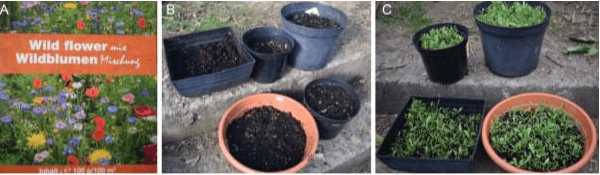
Figure 1. Preparation of the wildflower miniature garden. (A) Wildflower seeds box. (B) Pots with soil and seeds. (C) A few weeks old wildflower garden.
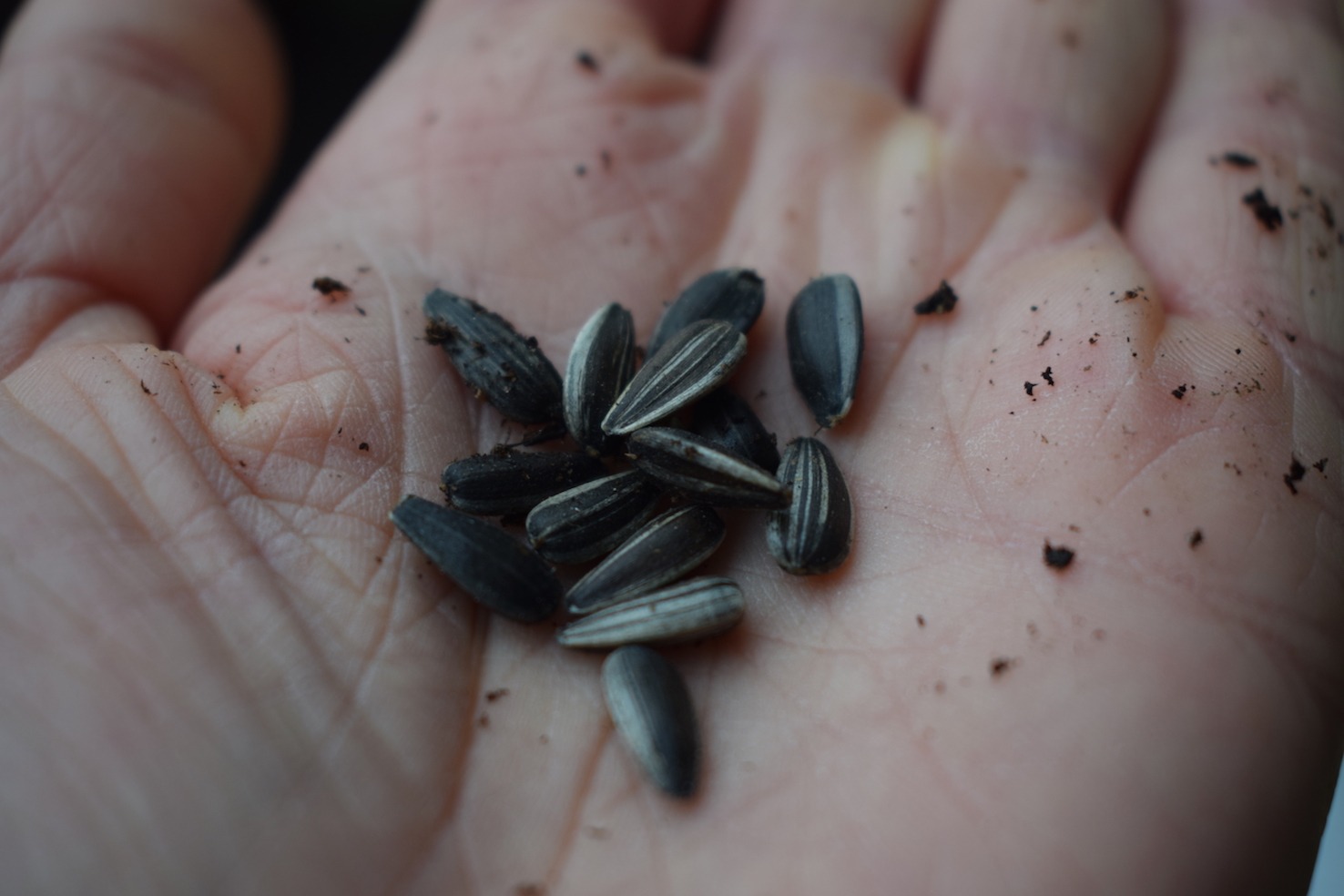
You can also use alternative ideas for blooming your small space. If you are already involved in bird feeding, you could remove a few sunflower seeds from the bird food (Fig.2A) and plant them in a pot (Fig.2B). Remember to place the pot in a sunny spot. Another way of creating your miniature garden could be growing cruciferous greens. This could be Chinese mustard (Fig2.C) or Land cress (Fig.2D), of which leaves are a delicious and healthy addition to your salads, but once left in a warm environment (e.g., kitchen windowsill), will form yellow flowers that can attract many pollinators.
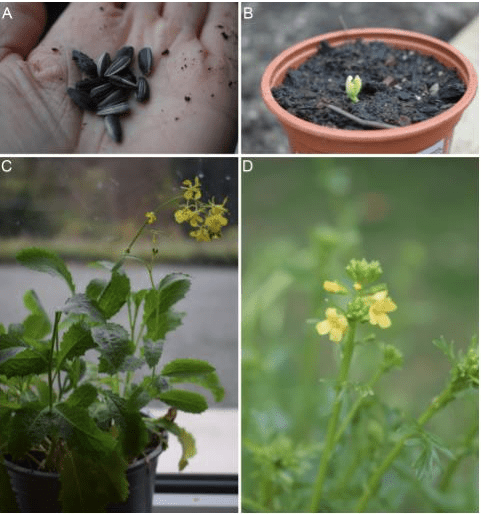
Figure 2. Alternative ways of creating a wildflower garden. (A) Sunflower seeds acquired from bird food. (B) Sunflower seedling. (C and D) Flowering cruciferous greens. (C) Chinese mustard in a windowsill. (D) Land cress in bloom.
Groenewegen, P. P., Van den Berg, A. E., De Vries, S., and Verheij, R. A. (2006). “Vitamin G: effects of green space on health, well-being, and social safety.” BMC Public Health 6(149).
Groenewegen, P. P., van den Berg, A. E., Maas, J., Verheij, R. A., and de Vries, S. (2012). “Is a green residential environment better for health? If so, why? .” Ann. Assoc. Am. Geogr 102: 996-1003.
Kuo, M. (2015). “How might contact with nature promote human health? Promising mechanisms and a possible central pathway.” Front. Psychol 6.
Images © Kamila Kwasniewska